In which the marsh offers an opinion, Donat proves unexpectedly useful, and an old acquaintance reminds me that volume is not the same as argument.
Ninth Day of the Rain Moon — Morning, then Noon, then Reluctantly, Evening — Donat: Day Seven
—————–
 She began at first light, as always, with a single blow of such percussive authority that it entered my sleep before I was finished with it and brought me upright in the chair where I had apparently spent the night, my cheek printed with the spiral binding of the water temperature notebook. I knew before I was fully conscious who it was. There is no other sound in this marsh, or in any marsh within a considerable radius, that carries that particular combination of violence and intention. The Pileated woodpecker, in which has been named, Marvine. She’s been working the dead cypress at the northwest edge of my property for eleven years, and in eleven years I have not grown accustomed to her. I do not believe she intends that I should.
Donat, for his part, opened one eye, assessed the situation, and closed it again. This is either equanimity or stupidity and I have not yet gathered sufficient data to determine which.
Marvine. I should describe her for the record, though I’ve done so at length in a Field Notebook Vol. XXIII and again in the monograph “Territorial Percussion: A Study in Dryocopus pileatus and the Ethics of Shared Borders,” which remains, like all my monographs, unread by anyone but myself and, on one occasion, a curious river otter who showed no signs of comprehension but lingered for three full pages, which I found more gratifying than I had any right to.
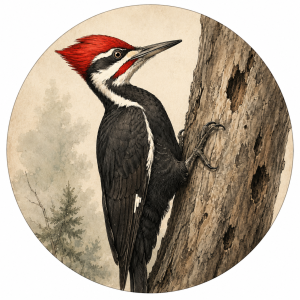
Marvine is large. This must be said first, because of those who’ve not stood in proximity to a pileated woodpecker tend to imagine something roughly sparrow-sized, something that could be held in a cupped hand. Marvine could not be held in a cupped hand. She could not be held in two cupped hands. She is nearly the length of my forearm from bill-tip to tail and she moves through the air with the blunt confidence of something that has never, in its entire evolutionary history, been uncertain of its welcome. The red crest blazes. The white stripe along the jaw is stark as a declaration. She is, aesthetically, excessive, and she knows it and finds the observation beneath acknowledgment.
We have a complicated history, Marvine and I. Not a warm one. Complicated.
Journal Entry:
In the early years of my residency here, I made the error that young naturalists often make, which is to assume that proximity to a remarkable creature entitles one to a relationship with it. I approached her study with the full apparatus of my method: the notebook, the measured distances, the careful non-intrusive observation. She responded to this attention the way she responds to most things, by hammering the cypress beside my head with what I can only describe as pointed commentary. I took the data and retreated. We’ve maintained, since then, a productive distance that I’ve come to regard as the most honest form of mutual respect available between two creatures of incompatible temperaments.
This morning, however, she came closer than usual.
I’d gone out after the first tea to check the lily study and to restore the days of missed water temperature readings to the record, walking the bank in the early grey light with my notebook tucked under one wing and the thermometer in hand, Donat trailing behind me at a distance that managed to suggest both companionship and plausible deniability. The rain had paused. The marsh was doing what it does in the gaps between rains: releasing everything it had absorbed, the smell of it rising in the warming air like a slow exhalation, dark and green and faintly sweet with decay, which is not an unpleasant smell once one understands that decay is simply transformation conducted at a pace too slow for the impatient to appreciate.
I was at the third measurement station, knee-deep in the shallows, when Marvine landed on the snag eight feet to my left.
She did not look at me. Pileated woodpeckers do not look at things so much as they orient toward them with the whole architecture of the skull, the great chisel bill leading, the red crest canted at angles that in another creature one might read as curiosity or challenge. In Marvine I have learned to read them as simply: I am aware of you. You are part of the data.
She struck the snag twice. Deep resonant blows, each one sending a tremor through the wood that I felt in the water aroundt my legs. Then she stopped and was perfectly still, listening to what she’d made, tilting her head to receive the interior echo of the tree. This is how they assess a log for chambers, for the hollow galleries of carpenter ants that are their primary purpose; they strike and then they listen to what comes back. They read the tree by what returns from it.
Donat, behind me, made his settling in sound.
Marvine’s crest rose a fraction. She struck the snag once more, listened, and then without any transition, without any preparation, without the slightest deference to the hour or the contemplative quality of the morning, she opened her bill and produced the call. If you have not heard it: imagine laughter that has never learned to be a polite laugh. Imagine something between a cry and a declaration, wild and territorial. It rang out across the water, hit the treeline, and came back diminished and lovely, and the marsh received it the way the marsh receives everything: completely without judgment.
I stood in the water with the thermometer in my hand recording my thought because it surprised me sufficiently to warrant it, that I could not remember ever making such a sound as this one. A sound that came from some interior pressure and simply had to get out, regardless of who was listening or what they would make of it. Marvine makes that sound and it is entirely irrelevant to her whether anything inside the marsh answers her back. She’s not waiting for a response. She is not measuring the reception. She calls because the call is in her and the call requires air.
I am a creature of considered output. Everything I produce, every notation, every monograph, every careful paragraph in this journal passes through several interior editors before it reaches the page. This is, I have always believed, what separates scholarship from noise. But standing in the shallows this morning with Marvine’s obnoxious noise still moving through the trees, I found myself entertained, only briefly and without any commitment to the possibility that I have confused precision with safety, and that they are not, in fact, the same instrument.
Journal Entry:
She left without any warning. One moment present, the next a red streak vanishing into the cypress, the sound of her wings briefly loud and then entirely gone. She left behind a fresh wound in the snag, pale wood exposed to the grey morning, and the echo of the call still thinning in the distance, and Donat standing in the shallows beside me up to his knees, watching the empty air where she had been with an expression I’ve no words to describe.
“She comes every few days,” I told him. I don’t know why I spoke aloud. I’m not in the habit of narrating the marsh to house guests. Perhaps Marvine’s noise had loosened something in me.
Donat turned and waded back toward the bank, pausing once to snap up a small fish by pure tactile reflex, the whole transaction taking less time than a thought.
I took the water temperature. I wrote it down, and began my walk back home.
This evening I’ve been sitting with a question about Marvine: what is the relationship between making oneself known and making oneself understood? She is known throughout this entire section of the marsh. Every creature within half a mile organizes some part of its morning around her. She is not understood, in any sense that I would apply to the word. She doesn’t require it. The knowing is sufficient. The call goes out. The air receives it. The record is made in the only medium she trusts, which is sound, which is immediate, which leaves no notebook behind and demands no future reader.
I’ve many years of notebooks. I’m understood by no one.
I’m not certain which of us has arrived at the sounder methodology.
Donat is asleep again. The candle is low. Through the left window, the old shack across the water shows a light tonight, which it hasn’t done in several weeks. Someone is there. Someone arrived while I was standing in the shallows being educated by a woodpecker, and I didn’t notice, which is precisely the sort of lapse in observation that Marvine would find, if she were capable of finding anything funny, very funny indeed.
I’ve noted the light. I’ve written it here. I’m watching it the way I watch all things from this desk: carefully, from a distance, with no immediate plan.
It is, I remind myself, early yet.
________________________
† “Marvine” is not a name I gave her. She arrived already named, in the sense that the sound she makes contains it if one listens. I’ve recorded the reasoning for this in a separate notebook. It’s not scientific reasoning. I keep it anyway.
‡ The water temperature: 68.4 degrees Fahrenheit at Station One, 67.1 at Station Two, 66.8 at Station Three. The three-day gap in readings shows a gradual decline consistent with the extended rain and reduced solar input. I note this here for completeness. It is the least interesting thing that happened today.