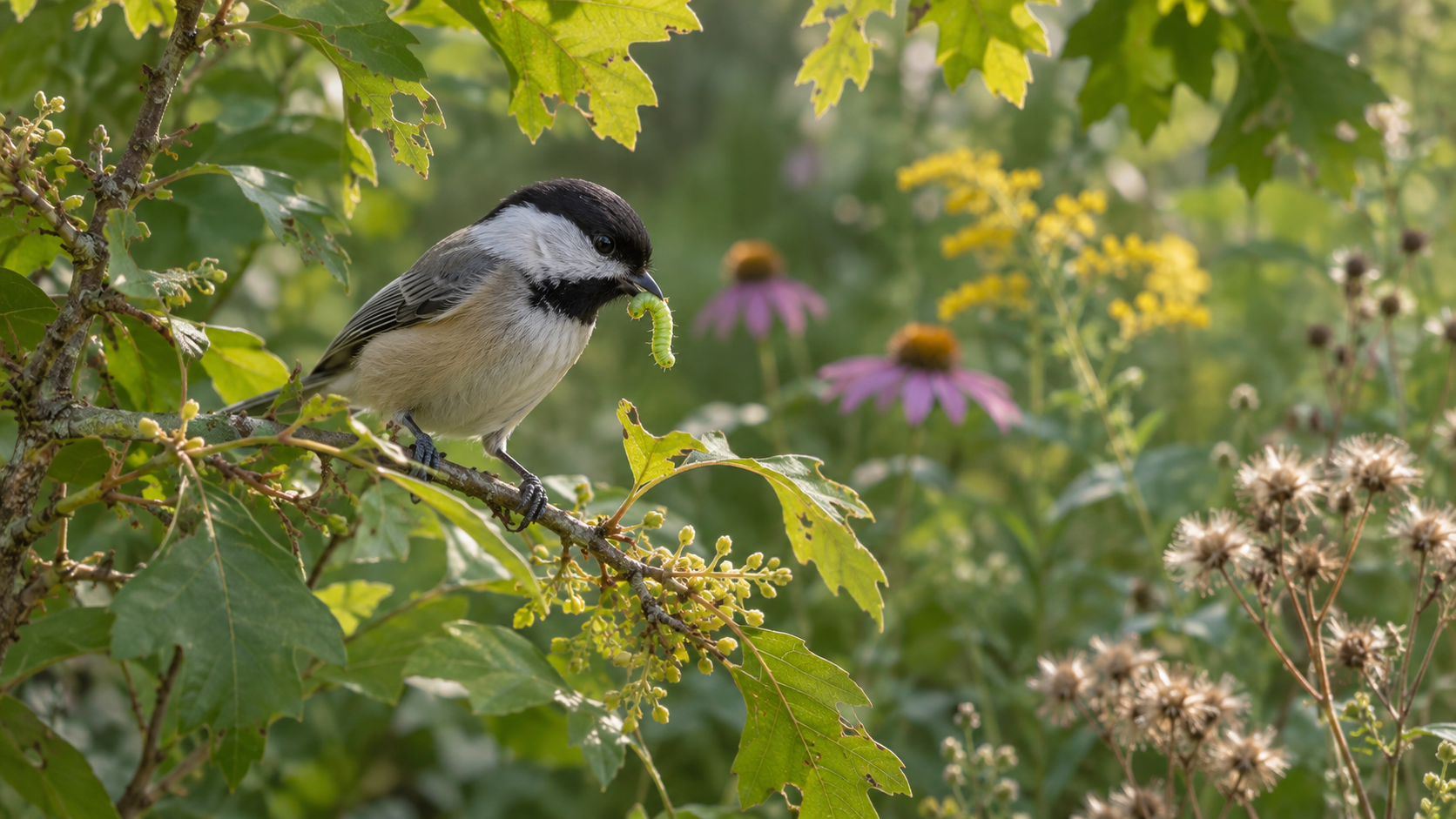
There is more going on in a garden than we can see from the porch. A chickadee slips among the leaves of a tree, pausing briefly before moving to the next branch. It is not looking for a flower or a place to perch. During nesting season, it may be searching for a caterpillar, one of the small, soft-bodied creatures that help keep its young alive.
We tend to judge gardens by what is visible: flowers in bloom, healthy foliage, neatly edged beds, perhaps a bird at the feeder. Birds are interested in a different set of things. To them, a garden is a place to find food, shelter, nesting material, and safety. Its value depends less on how it looks than on what can live there.
The food we rarely notice
Many familiar backyard birds eat seeds and fruit, and those foods are important. But when the breeding season arrives, insects become essential to many species. Caterpillars, spiders, and other small invertebrates provide nutrients for growing nestlings. A parent bird may make hundreds of trips between its nest and the surrounding vegetation, carrying food that would be easy for us to overlook.
Consider the Carolina Chickadee. In a 2018 study published in Proceedings of the National Academy of Sciences, conservation scientist Desirée L. Narango and colleagues Douglas W. Tallamy and Peter P. Marra examined chickadees living in residential landscapes around Washington, D.C. They wanted to know whether the plants chosen by homeowners affected the birds’ ability to raise young.
They found that yards with a greater proportion of nonnative plants tended to support fewer caterpillars and spiders. Chickadees in those landscapes had less of their preferred food available, and their reproductive success suffered. In the landscapes studied, populations were more likely to sustain themselves when native plants made up more than 70 percent of plant biomass. That figure is a result from those particular chickadee populations and neighborhoods, not a universal prescription for every garden. Read the original study.
The finding changes how we might look at a tree. The leaves are not merely a green backdrop for the bird. They are also food for insects, which become food for the bird. A tree can be part of a chain of relationships that extends all the way to a nest full of young chickadees.
Why the kind of plant matters
Plants and insects have developed relationships over long periods of time. Many plant-eating insects can use only particular plant groups as food for their young. A butterfly may visit several kinds of flowers for nectar, yet its caterpillars may depend on a much narrower selection of host plants. When those hosts disappear from a landscape, the insects that need them may disappear as well.
This is one reason native trees, shrubs, grasses, and wildflowers matter. They support insects that local birds have long relied upon. An ornamental shrub may be beautiful and still support relatively little insect life. Another plant may have leaves marked by chewing caterpillars and be doing valuable work.
Of course, native does not automatically mean useful in every circumstance, and not every nonnative plant is equally harmful. A plant’s value depends on the species, the region, and the wildlife using it. But the general lesson from the chickadee research is difficult to ignore: the composition of a garden can affect whether a bird finds enough food to raise a family.
A garden is more than its flowers
Bird habitat has layers. Tall trees offer nesting places, shade, and insects among the branches. Shrubs provide cover and sometimes berries. Flowering plants can feed pollinators, while seeds left standing through autumn and winter can feed finches and sparrows. Fallen leaves shelter invertebrates and other small creatures close to the soil.
For a bird, these parts belong together. A nest box in an otherwise bare yard might provide a place to nest, but it cannot supply the food needed to raise the young. A feeder may bring birds close to our windows, but it does not replace the living food web in the surrounding vegetation.
There are practical ways to make a garden more useful without redesigning the entire property. Start by identifying the trees and shrubs already growing there. Keep healthy native plants where they make sense, and consider adding locally appropriate species that provide insect habitat, seeds, or fruit. Allow a safe corner to hold fallen leaves and standing stems. Where possible, avoid broad-spectrum insecticides that remove the very insects birds need.
Water matters, too, as does cover from predators and harsh weather. The Smithsonian’s bird-friendly yard guidance recommends thinking about the whole habitat rather than a single attractive feature. For plant choices, the National Wildlife Federation’s Native Plant Finder offers a place to begin with local species.
Look again at the leaves
One of the pleasures of watching birds is that they lead our attention elsewhere. A warbler pauses in an oak, and suddenly we want to know what it found there. A chickadee leaves the nest carrying an empty moment in its beak, then returns with an insect, and we begin to see the tree differently.
We do not need to turn every yard into wilderness. We can begin by noticing what the birds are asking of the places we cultivate. A few chewed leaves may be evidence of a functioning relationship rather than a gardening failure. A patch of native growth may hold a better meal than a bed of flawless ornamentals.
The garden that feeds the birds is not always the neatest garden on the street. It is the one in which enough other lives are being fed, too.
Further reading
Narango, D. L., Tallamy, D. W., & Marra, P. P. (2018). Nonnative plants reduce population growth of an insectivorous bird. Proceedings of the National Academy of Sciences, 115(45), 11549–11554.
Cornell Lab of Ornithology: To Bring Birds to Your Garden, Grow Native Plants.